
Rethinking the Water Crisis
Across South Africa, water shortages are almost always explained the same way: not enough rain. When dam levels drop and municipalities impose restrictions, the narrative defaults to drought. Rain is the variable. Rain is the problem.
But this framing, repeated often enough, has created a dangerous passivity. If water security depends on weather — and weather is beyond our control — then there is very little for individuals, farms, businesses, or communities to do except wait. And hope.
The reality is fundamentally different. In many cases, the rainfall South Africa receives is not the primary constraint on water availability. What is constraining is the infrastructure — or the near-total absence of it — to capture, store, and use what arrives.
And beneath the surface, largely invisible to public awareness and national planning alike, there is a further dimension to the water picture that makes the storage argument even more urgent: a vast layer of deep groundwater that has been flowing through ancient geological networks for centuries, largely untapped, because we have not built the local infrastructure to access and hold it.
Rainfall Is Variable. Water
Demand Is Constant.
South Africa receives most of its rainfall in concentrated seasonal periods. The Highveld summer thunderstorms, the Western Cape winter rains, the subtropical downpours of KwaZulu-Natal — these are intense, periodic, and often dramatic. They are not, in many regions, insufficient. What they are is uneven in time.
Water demand, by contrast, does not fluctuate with the seasons. Crops need irrigation through dry months. Livestock drink every day. Factories run year-round. Households require water in January exactly as much as in July.
The gap between seasonal, variable rainfall and constant, year-round demand is precisely what storage infrastructure exists to close. When rainfall is captured during wet periods and stored effectively, it becomes a reliable resource during dry ones. When it is not captured — when it runs off into rivers and flows to the sea within days of falling — it is lost to the system entirely, regardless of how much of it fell.
South Africa loses an enormous proportion of its rainfall this way. Not because storage is impossible, but because storage infrastructure at the local and farm level is chronically underdeveloped.
The consequence is predictable: communities and industries experience the same cycle, year after year. Heavy rainfall events. Rapid runoff. Months later, water shortages. The rain was not the problem. The infrastructure was.
Water Security Is Built...
Not Wished For
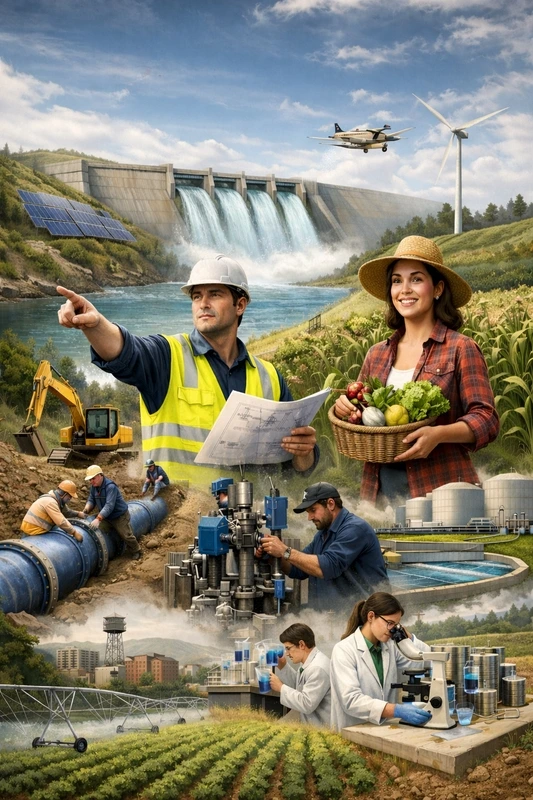
Water security is an engineering and infrastructure outcome. It is produced by deliberate design — by systems that capture water when it is available, store it reliably, and deliver it consistently when and where it is needed. Communities and operations that have invested in proper storage infrastructure experience water security.
The Layer Beneath: What Most
Water Planning Misses
The storage argument is powerful enough when applied to surface rainfall alone. But there is a dimension to South Africa's water picture that makes it even more compelling — and that conventional water education almost entirely ignores.
Beneath the shallow boreholes and aquifers that most farms and municipalities rely on, there exist deep aquifer networks of a scale and extent that most people would find surprising. These are not simply underground pools that refill from local rainfall. They are interconnected systems of permeable geological formations and fracture-based conduits — what hydrogeologists call deep seated water networks — that carry groundwater across distances of hundreds to thousands of kilometres, largely independent of local rainfall patterns.
A landmark study from Princeton University and the University of Arizona, published in January 2025, mapped these systems at continental scale and found that deep groundwater contributes more than half of baseflow in the majority of studied river basins — driven not by local recharge from surface rainfall, but by subsurface flows operating on regional and continental scales.
What this means for South Africa is significant. Large parts of the country classified as water-scarce on the basis of surface rainfall and shallow aquifer availability may sit above deep groundwater resources that existing planning frameworks do not account for. The water inventory available to South Africa — and to individual farms and communities within it — may be substantially larger than the conventional model suggests.
But here is the critical connection: even if that water exists underground, it is inaccessible without infrastructure. A borehole that reaches deep aquifer water still needs storage at the surface. A rainwater harvesting system still needs a tank to hold what it captures. A municipal scheme that draws on a local groundwater source still needs reservoirs and distribution infrastructure to deliver it.
Water that exists but cannot be held is water that cannot be used. The storage argument applies to every source — surface or subsurface.
The Infrastructure Gap South
Africa Cannot Afford to Ignore
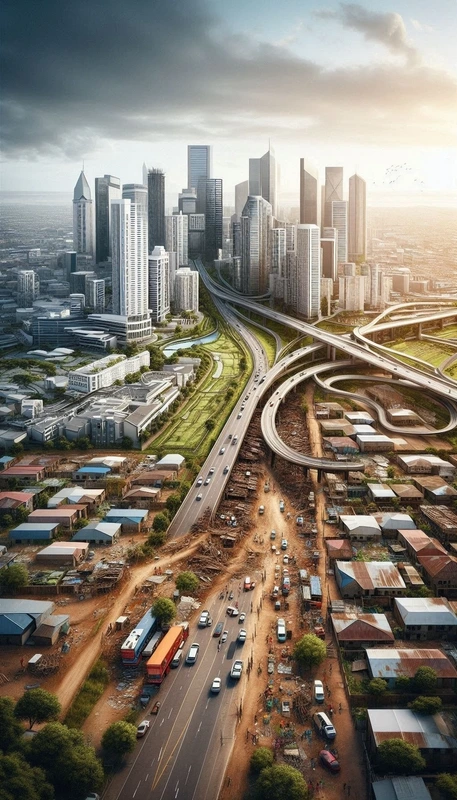
The gap between South Africa's water potential and its water security is, in large measure, an infrastructure gap. Not just at the national level — at the local level. At the farm level. At the estate and factory and school level.
Every farm that installs a properly engineered steel tank closes part of that gap for itself — and reduces pressure on the municipal and bulk supply systems that everyone draws from. Every estate that harvests and stores rainwater independently adds resilience to the broader system.
Every industrial facility that maintains its own water reserve stops being a point of vulnerability and becomes a point of strength.
The shift required is not technological — the technology exists, it is proven, and it has existed for decades. The shift required is conceptual: from treating water storage as an optional extra to treating it as foundational infrastructure, as essential to a property or operation as electrical supply or road access.
Rain will always be variable. Climate will always shift. But the capacity to capture, store, and manage water effectively is entirely within our control.
From agricultural operations to commercial developments and industrial sites, properly designed steel water storage systems help transform unpredictable rainfall into dependable water security.
Conclusion
That is why rain is not the problem. Storage is the solution — for the water that falls from the sky, and for the water waiting to be found beneath our feet.