
Water is life. Yet for millions of households, businesses, and farms across South Africa, the idea of "unlimited municipal water" is not a guarantee — it is a myth. A promise that cannot withstand the realities of ageing infrastructure, underfunded services, climatic pressure, and population growth pressing against a system never designed to absorb all of it.
At Aquadam, we believe that genuine water security requires honest thinking — not just about why the current system is failing, but about what the full picture of available water actually looks like. Both insights are necessary before you can build something better.
Centralized Water Supply: A Fragile System
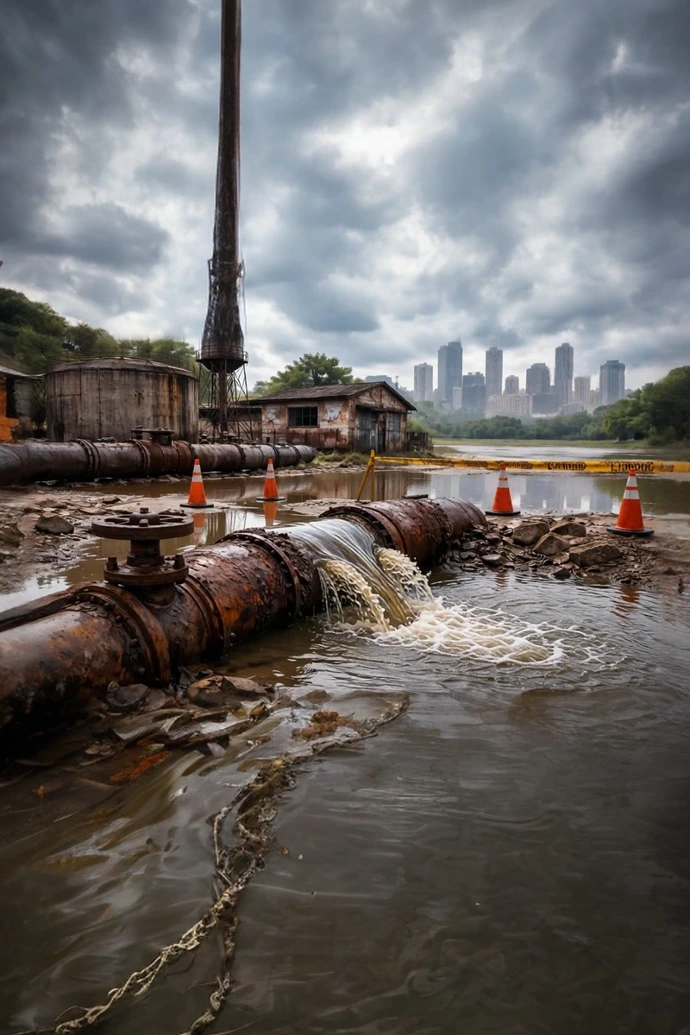
Municipal water systems are often portrayed as robust, well-engineered networks designed to deliver fresh water to every tap. In practice, many centralised systems carry deep, structural vulnerabilities that have compounded over decades.
Ageing infrastructure is the most visible problem. Across South Africa's cities and towns, water distribution networks built in the mid-twentieth century are deteriorating. Pipe failures, chronic leaks, and pressure losses mean that significant volumes of treated water never reach the consumer — they are lost in the ground before they get there. In some municipalities, non-revenue water losses exceed 40% of total supply.
Governance and revenue failures compound the infrastructure problem. When consumers don't pay — and when municipalities lack the technical capacity to manage complex water systems — the budget for maintenance collapses. Deferred maintenance accelerates network degradation, which reduces reliability, which erodes consumer trust, which reduces payment rates further. The cycle is self-reinforcing and very difficult to break.
Demand growth steadily outpaces the system's capacity to keep up. South Africa's urban population has grown substantially since the bulk of its water infrastructure was originally planned and built. Networks designed for smaller, lower-density populations are now being asked to serve larger, higher-density ones — without the capital investment needed to match that growth.
Climate variability is the pressure that tips a stressed system into crisis. Reduced rainfall and more frequent drought years mean that the reservoirs feeding municipal distribution systems operate at lower average levels than historical design assumptions anticipated. When a drought year coincides with infrastructure in poor condition and governance under stress, the result is what South Africans have experienced in Johannesburg, Cape Town, and numerous secondary municipalities: not a water shortage caused by nature alone, but a system failure caused by the collision of multiple pressures on an inadequate foundation.
The Deeper Problem: A Dangerously Incomplete Water Picture
Here is what rarely enters the public conversation about water scarcity — and what makes the municipal water myth even more damaging than it first appears.
The dominant narrative holds that South Africa is water-scarce because it is a dry country: limited rainfall, limited surface water, limited options. This narrative is not false — but it is dramatically incomplete. And that incompleteness shapes policy, planning, and public thinking in ways that make the problem harder to solve than it needs to be.
Beneath the surface water systems — beneath the dams, beneath the reservoirs, beneath the shallow boreholes that most municipalities and farms rely on — lie deep aquifer networks that most hydrogeological planning frameworks have barely begun to account for.
These are not simply underground pools that refill when it rains locally. They are vast, interconnected systems of permeable geological formations and fracture-based conduits that carry water across distances of hundreds to thousands of kilometres. Recent research from Princeton University and the University of Arizona, published in January 2025, produced a continental-scale groundwater simulation confirming what a growing body of subsurface science has been suggesting: deep groundwater systems operate on scales far larger than local surface drainage areas, contributing more than half of baseflow in the majority of studied river basins — largely independent of local rainfall patterns.
The U.S. National Groundwater Association estimates there are 22.6 million cubic kilometres of groundwater in the upper two kilometres of Earth's crust — enough to supply the world for over 6,000 years at current consumption rates.
South Africa sits on ancient, tectonically complex geology with significant deep aquifer potential that remains largely uncharted in operational water planning. The assumption that our water inventory begins and ends with surface rainfall — and that our choices are therefore limited to dams and municipal supply — is an assumption worth examining very carefully.
This does not mean water scarcity isn't real. It means the solution space is larger than the narrative allows.
Moving Beyond the Myth
The notion that municipal water supplies are limitless is clearly untenable. But so is the idea that water itself is simply scarce and that communities must simply endure less of it.
The more accurate and more useful framing is this: South Africa has a water distribution and storage problem as much as a water supply problem. The full inventory of water — surface and deep — may be more substantial than conventional planning assumes. But none of that water is useful without the infrastructure to capture, store, and deliver it at the right place, at the right time, in the right condition.
This is where decentralised storage infrastructure becomes not an optional convenience, but a structural necessity. The ability to capture water — from rainfall, from boreholes, from treated municipal supply during periods of availability — and store it securely at the point of use is what transforms an unreliable system into a resilient one.
Every farm, estate, business, and community that invests in its own water storage capacity reduces its exposure to municipal failure, contributes to overall system resilience, and takes a concrete step toward water security that does not depend on a fragile centralised promise.
Conclusion