
Skip to Content
Aquadam Steel Tanks
  • Home
  • About Us
  • Services/Products
    About us Partners Customers
      Products Services Help center
    Our blog Events Guides

    The team

    Since our inception in 1992, we have continually evolved and innovated to meet the ever-changing needs of our customers.  

    Discover our team
  • Blog/News
  • Contact
  • 0
  • Sign in
  • Quote Now
Aquadam Steel Tanks
  • 0
    • Home
    • About Us
    • Services/Products
    • Blog/News
    • Contact
  • Sign in
  • Quote Now

HOW BIG IS BIG ENOUGH

A Practical Guide to Sizing your Water Storage Tank.The Single Question That Determines Whether Your Tank Solves Your Water Problem
  • All Blogs
  • Steel Tanks
  • HOW BIG IS BIG ENOUGH
  • July 28, 2026 by
    HOW BIG IS BIG ENOUGH
    Aquasteel PTY Ltd, Ronald van Lochem


    Ask ten property owners why they chose the tank size they did, and most will give you the same answer: it was what fit the budget, or it was what the neighbor has, or it "seemed like a lot." Almost none of them calculated it.
    That is the single biggest gap in South Africa's water storage market — not awareness(most people now understand they need a tank), but sizing discipline. And it is the gap that determines whether a tank actually solves the water problem it was bought to solve, or simply delays it by a few weeks.

    Right-sizing a tank is not guesswork. It is arithmetic applied to four inputs: daily demand, source reliability, required buffer duration, and growth headroom. Get those four numbers right, and the tank size follows logically. Skip them, and you are choosing a number that feels safe rather than one that is safe.
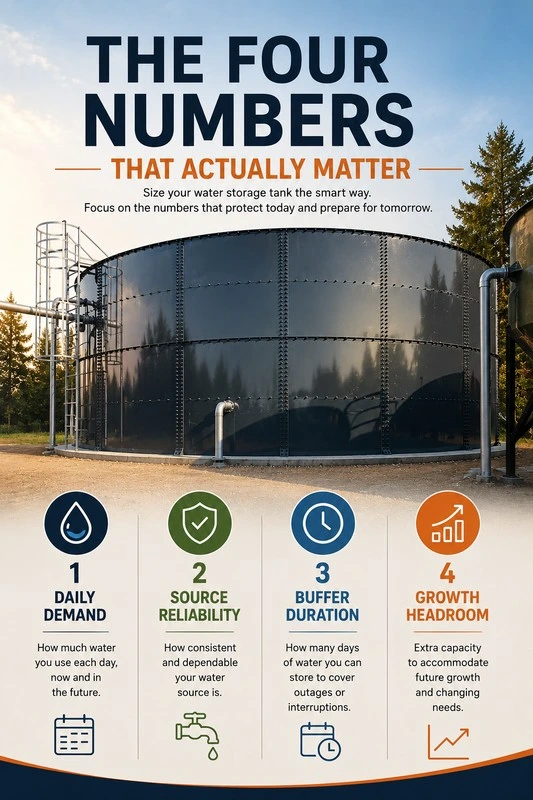

    The Four Numbers That Actually Matter: 
    Daily demand.

    This is the water actually consumed or required per day — by people, livestock, irrigation cycles, or industrial process. It is rarely a single number; it has a baseline and a peak (a farm's irrigation demand in December is not its demand in June; a

    school's demand in term time is not its demand in the holidays). Sizing on the average and ignoring the peak is the single most common mistake we see.

    Source reliability..

    A tank does not create water — it holds water that a source produces intermittently and releases it on demand.

    A borehole that yields consistently, a municipal connection that rarely fails, and a rooftop catchment that depends entirely on rainfall all require different storage strategies, even at identical demand levels. The less reliable or less continuous the source, the larger the buffer the tank needs to carry.

    Buffer duration.

    How many days without fresh input does the operation need to survive? For a household, that might mean surviving a weekend outage. For a farm through a dry spell, it might mean weeks. For a factory where a shutdown carries contractual penalties, "how many days" is really a financial risk question disguised as an engineering one.

    Growth headroom.

    A tank sized precisely for today's demand is often undersized for next year's. Herds grow, production lines expand, households add boreholes or swimming pools. Sizing with a margin for the next three to five years is usually cheaper than expanding later.

    Why Both Directions of the Mistake Are Expensive

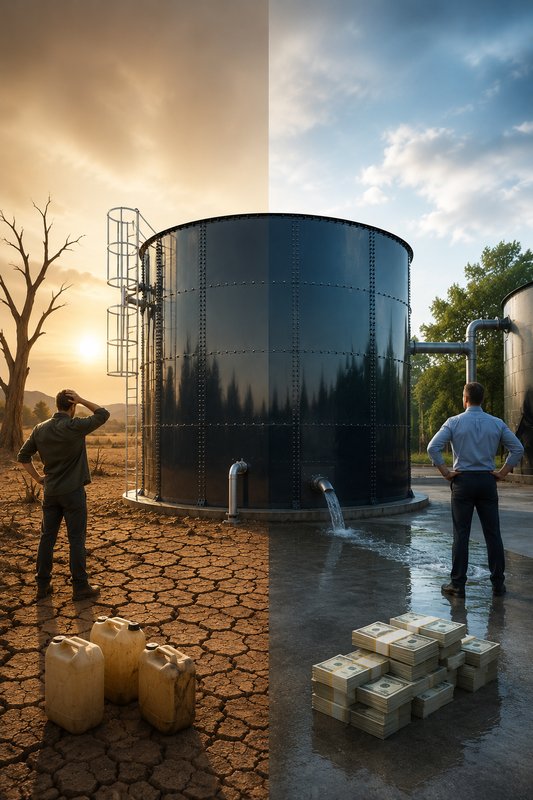
    Under sizing is the more visible failure — the tank runs dry mid-crisis, exactly when it was needed most. 

    But oversizing carries its own cost: capital tied up in steel that will sit mostly empty for years, a larger footprint and foundation than the site strictly requires, and a payback period on the investment that stretches out further than it needed to.

    The goal is not the biggest tank. It is the right tank — sized against actual demand, actual source behavior, and an honest buffer target, with headroom built in deliberately rather than added as an afterthought guess.
    What This Looks Like in Practice

    A household protecting itself against municipal outages needs a different calculation than a dairy farm buffering against a borehole that only produces reliably at night, which is different again from a school that cannot legally operate without water, which is different again from a factory where an hour of downtime costs more than a year of storage. The same four-number framework applies in every case. Only the inputs change.
    This is also why a generic size recommendation — "get the 10,000-litre one, it's popular" —is close to useless. Two properties with identical footprints can have completely different correct answers once actual demand, source, and buffer requirements are run through the calculation.

    The Actual Fix

    Before buying a tank, know your daily demand (with its peak, not just its average), knowhow reliable your water source actually is, decide honestly how many days of independence you need, and build in headroom for where the property is heading — not just where it is today.
    This is precisely the assessment our sales team runs for every serious enquiry: not "what's your budget," but "what's your actual demand profile." It takes minutes to walk through, and

    it is the difference between a tank that solves the problem and a tank that just looks like it did.

    Aquadam Steel Tanks International has engineered steel water storage solutions for South African farms, municipalities, industries, and homes for over three decades. Whatever the sector — Home Tank, Smart Tank, Dura Tank, or Rhino Tank - our team will run the sizing calculation with you before you commit to a number.

     Get in Touch now

    Aquadam
     

    Aquadam Steel Tanks
    International has been engineering steel water storage solutions for South African farms, municipalities, industries, and homes for over 30 years. Our range — from the 2,500-litre Home Tank to the 5-million-litre Dura Tank and Rhino Tank — is the foundational storage infrastructure for every ground-level water security architecture.
    in Steel Tanks
    # Aquadam Extreme Tank dura tank rhino tank
    HOW BIG IS BIG ENOUGH
    Aquasteel PTY Ltd, Ronald van Lochem July 28, 2026
    Share this post
    Our blogs
    • Steel Tanks
    • News Blog
    Water Security Starts at Ground Level
    Why Farms, Estates, Factories, Schools, and Homes Are the Real First Line of Water Defence — And What That Requires in Practice

    Get in Touch ​

    Aquadam - Get in Touch


    Submit

    Thank You For Your Feedback

    Our team will message you back as soon as possible.
    In the meantime we invite you to visit our website.


    Aquadam Logo


    Water Storage Is Not A Product. It Is A Risk Decision.

    Aquadam engineers water storage tanks systems in South Africa that transfer risk away from 

    the owner — and into performance-backed steel infrastructure.

    USEFUL LINKS:

    Home
    About
    Legal
    Contact Us
    Get a Quote 
    Terms

    311 Alwyn Str, Waltloo • Pretoria• South Africa

    sales@aquadam.co.za

    Copyright © Aquadam Steel Tanks Int. 2026
    Powered by Odoo - The #1 Open Source eCommerce